Many "best bookkeeping courses" roundup lists recycle the same small set of platforms, ranked by star rating or price, with no real explanation of who each course actually serves. What those lists skip is the part that matters most: whether the program will prepare you to sit across from a real client, open their books, and do the work competently. If you're trying to find the best online bookkeeping courses for your specific situation, the ranking criteria matter as much as the rankings themselves.
The difference between landing a bookkeeping client in six months and spinning your wheels on generic coursework usually comes down to curriculum structure, instructor credentials, and what happens after you finish. Brass Jacks Bookkeeping Collective has reframed what a bookkeeping education can look like, with leveled coursework, active-practitioner instructors, and a built-in path to real clients. That standard is what every other program in this roundup is measured against.
This breakdown covers the top online bookkeeping courses for 2026 by cost, format, skill depth, QuickBooks inclusion, and career support. By the end, you'll know exactly which one fits your goal.
Before you compare prices and platforms, you need a reliable filter. Most comparison lists rank courses by popularity or marketing budget, not by whether the course will prepare you to work with real numbers for real clients. A few criteria consistently separate programs that deliver from programs that just deliver a PDF.
A leveled, sequential curriculum produces more job-ready bookkeepers than a flat, one-size-fits-all program. A beginner who jumps straight into payroll or non-profit accounting without first mastering debits, credits, and reconciliations is set up to fail. Look for programs that build on each skill tier before advancing you to the next. This mirrors how accounting knowledge actually compounds: foundational skills have to be solid before specialized applications make sense.
There is a meaningful difference between a professor who teaches accounting theory and a working bookkeeper who managed client books last week. When evaluating instructors, verify their industry certifications, years of active practice, and whether they update curriculum when tax rules or software changes. Stale coursework is a real problem in online education, and bookkeeping is a field where regulations and software evolve constantly.
Most programs hand you a PDF and walk away. The programs worth paying for offer something more: job boards, career coaching, resume review, or a direct matchmaking pipeline to businesses actively hiring bookkeepers. This is where the majority of online bookkeeping courses fall flat, and where a small number genuinely stand out.
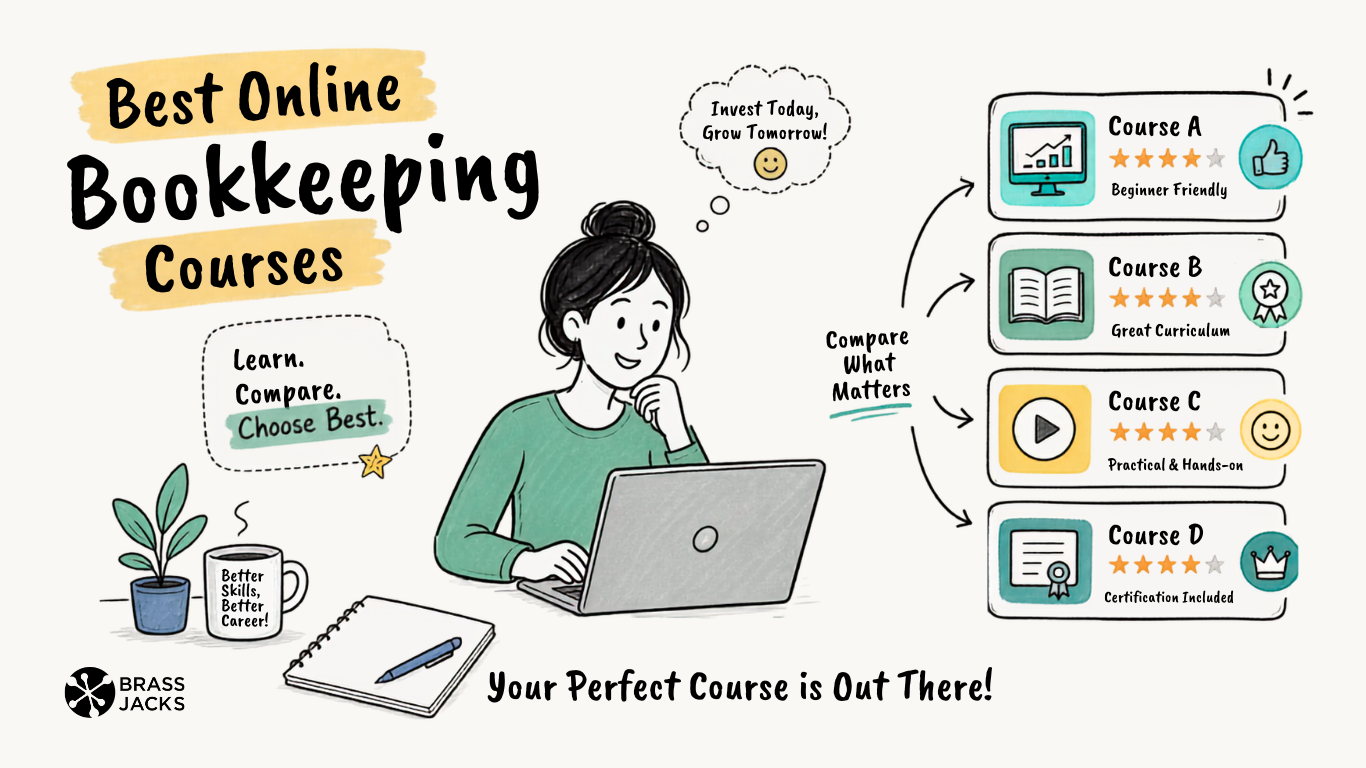
Here is how the major programs stack up across cost, format, depth, and career support.
Brass Jacks operates like a college course catalog for bookkeeping, which is the clearest structural advantage it has over every other program in this roundup. The tiered catalog starts at BK 100 DIY Books, a focused mini-course for micro-business owners managing their own books, and moves through BK 150 Year End Bookkeeping, BK 200 Cashflow Strategy, and BK 250 Bookkeeping Foundations (the primary career-entry course, offered three times per year). Advanced learners can continue into BK 300 Non-Profit Bookkeeping, a 10-week deep dive into grant tracking, restricted revenue, and board reporting, and BK 350 Job Cost Accounting, 10 weeks covering labor burden calculation and accurate job pricing.
A standout feature not commonly found in this roundup is the bookkeeper-to-business matching service. Graduates of
Bookkeeping Foundations are connected with actual businesses seeking qualified bookkeepers, which creates a real career pipeline rather than just a completion credential. The instructors are credentialed, active practitioners, which means the curriculum reflects how bookkeeping actually works right now, not how it worked when a textbook was written.
Intuit Academy Bookkeeping on Coursera is a strong free-to-low-cost beginner option. At a typical pace of less than four hours per week, most learners finish in about four months at roughly $160 total. The program delivers an employer-recognized certificate and integrates QuickBooks Online practice throughout, making it a reasonable orientation step before committing to a more structured program. QuickBooks ProAdvisor certification is free through the ProAdvisor portal and is well-recognized by employers who run QBO. Neither program offers structured skill progression beyond the beginner level, and neither includes career placement support.
These are the main recognized credentials for experienced bookkeepers who want formal letters after their name. The
NACPB Certified Public Bookkeeper (CPB) program runs $4,320 for members or $5,400 for non-members over 12 months. The
AIPB Certified Bookkeeper costs around $574 to $1,200 depending on what is bundled, and requires proof of two years of full-time bookkeeping experience or 3,000 hours part-time. Both credentials carry strong employer recognition. Neither is a training program with sequenced curriculum: they test knowledge you already have, and neither offers career placement or job support.
Penn Foster's bookkeeping career diploma runs $589 to $789. US Career Institute's bookkeeping certificate is $589 paid in full. US Career Institute's Career Coach Program includes resume and interview prep, which is the closest this comparison group comes to a direct job-placement service, though it stops well short of connecting graduates with actual employers. These programs are general-purpose career training: accessible and affordable, but without the industry depth or specialization options that professional bookkeepers need to command stronger rates.
Free courses are available, and some are genuinely useful for building a baseline. Whether free is enough depends almost entirely on what you plan to do with the knowledge.
The strongest free options include Intuit Academy (free to audit, paid for the certificate), ACCA Introduction to Bookkeeping (free course, $99 for the certificate), AccountingCoach (free lessons with a Certificate of Excellence milestone), Alison's bookkeeping catalog (free access, paid credential), and OpenLearn's Introduction to Bookkeeping and Accounting (free with a statement of participation). Typical skills covered across these programs include:
- Double-entry bookkeeping, debits, and credits
- The accounting cycle, journal entries, and trial balance
- Reconciliations, accounts payable and receivable, and basic financial statements
- Basic QuickBooks Online practice in Intuit-based courses
Free courses are adequate for someone who wants to understand bookkeeping basics or manage their own simple books. They are not adequate for someone pursuing a bookkeeping career, taking on clients, or working in specialized fields like non-profit accounting or job cost accounting. The gap most free learners eventually hit is the absence of instructor feedback, structured skill progression, and career support. They know the theory but can't confidently apply it to a real client's books, and they have no support system to bridge that gap.
QuickBooks Online is used by a significant share of small businesses in the U.S., so a bookkeeping course that ignores it leaves a real gap in your practical skill set. Here is how the main programs handle it.
Intuit Academy Bookkeeping integrates QuickBooks Online practice throughout its certificate program and is a solid beginner-level QBO training option tied to a bookkeeping curriculum. Access Computer Training's Bookkeeping with QuickBooks course includes dedicated QuickBooks and Excel modules covering company setup through payroll at a beginner-to-intermediate level. ONLC offers three QuickBooks skill levels (Level 1 through Level 3) as stand-alone tracks for learners who want focused software training. Brass Jacks' curriculum teaches in QuickBooks Online, QuickBooks Desktop, and Brass Jacks Bookkeeper, depending on the class, with practical workflow integrations woven into coursework, and BK 350 Job Cost Accounting covers software applications directly relevant to job costing scenarios.
QuickBooks ProAdvisor certification is free and well-recognized by employers who use QBO. But it is a software credential, not a bookkeeping education. Passing the ProAdvisor exam does not mean you understand the accounting principles behind what you are clicking. Most employer job postings for bookkeepers require experience with GAAP, accrual accounting, and reconciliation skills that the ProAdvisor exam does not test. The strongest setup is a solid bookkeeping foundation combined with QBO proficiency. One without the other leaves gaps that show up the moment a client hands you a complicated set of books.
Costs range from free to over $5,000. Formats range from 10-hour self-paced modules to 10-week structured cohorts. The right choice depends entirely on where you are now and where you are trying to go.
Career changers need sequenced skill-building, not a single certificate. The clearest path is BK 250 Bookkeeping Foundations at Brass Jacks, offered in structured terms throughout the year. From there, a specialization in BK 300 or BK 350 positions you for specific client niches, and the matchmaking service connects you with businesses actively hiring. If you want a low-cost orientation step before committing to a structured program, Intuit Academy on Coursera at roughly $160 is a reasonable starting point, not a destination.
You don't need a professional certificate. You need practical, no-jargon training on the tasks you face week to week: reconciling accounts, preparing clean records for your CPA, and understanding your cash flow. BK 100 DIY Books and BK 150 Year End Bookkeeping were purpose-built for exactly this situation. They are focused, affordable, and skip everything that's irrelevant to someone running a business rather than building a bookkeeping practice.
If you already handle general bookkeeping and want to command higher rates or serve a specific niche, a stand-alone specialization course is the right move. BK 300 Non-Profit Bookkeeping and BK 350 Job Cost Accounting offer 10 weeks of focused depth that free platforms and generic career courses don't replicate. Professional credentials like NACPB or AIPB are worth pursuing after you've built that specialized knowledge base, not as a replacement for it. Sitting for a certification exam before you've developed real applied skills is a way to pay a lot of money for a credential that doesn't reflect your actual capabilities yet.
Free courses work for orientation and self-education. Single-credential programs like NACPB and AIPB work for experienced bookkeepers who want formal recognition. Structured, leveled programs like Brass Jacks Bookkeeping Collective work for anyone building or advancing a bookkeeping career from the ground up.
The bookkeeper-to-business matching service is a relatively uncommon offering in this comparison, and it changes what a completion credential actually means. A certificate proves you finished a course. A direct pipeline to businesses hiring bookkeepers signals the school stands behind its graduates. If you're serious about turning bookkeeping skills into a career or a client roster, that pipeline matters more than any PDF certificate.
Finding the best online bookkeeping courses isn't just about price or platform reputation. It's about matching the program's structure, depth, and post-completion support to your specific goal. Browse the Brass Jacks course catalog at your current skill level and pick the tier that matches where you are today. The structured path from BK 100 through BK 350 exists precisely so you don't have to guess what to learn next or go it alone after you finish.