Choosing bookkeeping software for a small business is one of the most important financial decisions you can make. The right tool helps you stay organized, track income and expenses, manage invoices, simplify tax prep, and avoid the chaos that comes from doing everything in spreadsheets. The wrong tool can create confusion, waste time, and make it harder to get a clear picture of your business.
If you’re comparing options, the best place to start is with how you actually run your business. Some owners need simple bookkeeping software for a solo operation. Others need payroll, job costing, or a system that can scale as the business grows. And for many small businesses, the biggest question is whether to choose cloud software with a monthly subscription or a desktop solution with a one-time purchase.
This guide walks you through what bookkeeping software does, how to compare the leading options, and how to choose a system that fits your business today without boxing you in tomorrow.
At its core, bookkeeping software helps you record and organize the financial activity of your business. Instead of tracking everything manually, you can use software to categorize transactions, reconcile accounts, generate reports, and keep your books ready for taxes or year-end review.
For most small businesses, that means less time spent managing numbers and more time focusing on operations, sales, and service delivery. Good bookkeeping software can also help you see trends in cash flow, spot issues early, and make better decisions throughout the year.
Not all bookkeeping tools are built for the same kind of business. Before you choose one, look closely at the features that matter most to your workflow.
Start with the basics: income and expense tracking, bank reconciliation, invoicing, reporting, and easy account setup. Then think about whether you need payroll, project or job tracking, multiple users, mobile access, or integrations with your other tools.
You should also pay attention to how the software is delivered. Cloud-based tools are convenient because you can access them anywhere and updates happen automatically. Desktop software can be a better fit if you want to own the software outright, avoid recurring subscription costs, or keep your data stored locally.
One of the biggest choices is whether to use cloud bookkeeping software or a desktop program.
Cloud software is usually easier to access, easier to share with a bookkeeper or accountant, and easier to scale. It tends to work well for businesses that need collaboration and constant access from multiple devices.
Desktop software is often preferred by business owners who want a one-time purchase, prefer to keep data on their own machine, or don’t want another monthly bill. For some small businesses, that model is a better financial fit over time.
The right answer depends on your priorities. If convenience and collaboration matter most, cloud software may be the best choice. If ownership and cost control matter more, desktop software may be the better fit.
Pricing is another major factor. Many bookkeeping tools use a monthly or annual subscription model. That can be fine if you want continuous updates and cloud access, but the cost adds up over time.
A one-time purchase can make more sense if you want predictable expenses and don’t want to pay forever for software you use every day. For some small businesses, especially those with tight budgets, that can be a major advantage.
The important thing is to look beyond the sticker price. Think about the total cost of ownership, including support, add-ons, payroll, user seats, and any integrations you’ll need.
The best bookkeeping software is not always the same for every business.
A freelancer may need something simple and affordable. A service business may need payroll and project tracking. A startup may want room to grow. A self-employed professional may care most about ease of use and low overhead.
That’s why it helps to compare options based on your business model, not just on brand recognition.
A good decision starts with a clear list of needs.
Ask yourself how many transactions you handle each month, whether you need payroll, whether more than one person will use the software, and whether you want cloud access or desktop ownership. Then decide how much complexity you can realistically manage.
If a tool is too basic, you’ll outgrow it quickly. If it’s too complicated, you’ll spend more time managing the software than managing the business. The best choice is usually the one that matches your current workflow while leaving room to grow.
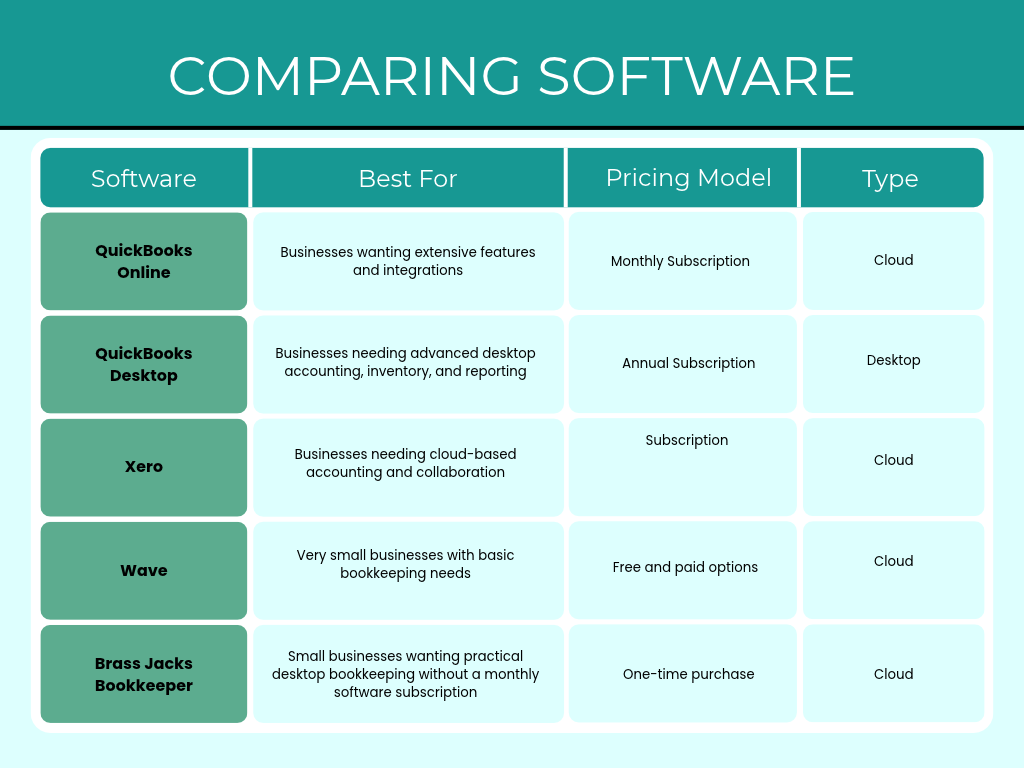
If you want a desktop bookkeeping solution with a one-time purchase model, Brass Jacks Bookkeeper is designed for small businesses that want more control and less subscription fatigue. It’s a strong fit for owners who want to keep their data local and avoid the endless cycle of monthly software costs.
It’s especially useful for small businesses that want straightforward bookkeeping without being pushed into a cloud-only model. And because Brass Jacks also teaches bookkeeping, it’s built with real-world small business bookkeeping needs in mind.
What makes it different:
- One-time software purchase rather than a recurring monthly subscription.
- Desktop software for Windows.
- Manage multiple companies under one license, depending on your license tier.
- Built by bookkeepers who understand the day-to-day needs of small businesses.
- Practical accounting and financial reporting tools.
- No need to pay for an expensive cloud platform if you don't need one.
It's not designed to be everything to everyone. If you need extensive third-party integrations, automatic bank feeds, or cloud access from multiple devices, another platform may be a better fit.
But if you're looking for straightforward desktop bookkeeping software and want to avoid another monthly subscription,
Brass Jacks Bookkeeper is worth a look.
Choosing bookkeeping software is really about choosing how you want to manage your business finances every month. The best system is the one that fits your size, your workflow, and your budget.
If you’re a small business owner, start with your must-have features, decide whether cloud or desktop is the better model, and choose software that helps you stay organized without creating extra work. From there, you can build a bookkeeping process that supports growth instead of slowing it down.